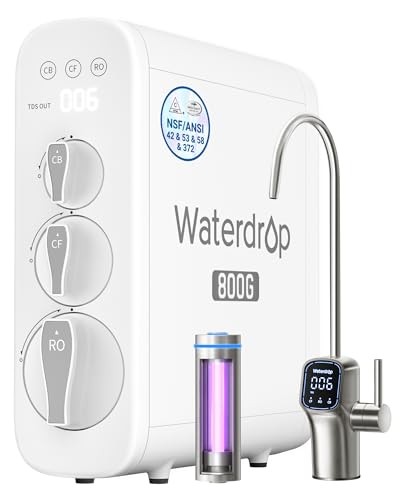
Given whole-house RO systems’ significant price range, understanding where premium pricing actually delivers meaningful improvement matters.
The gap between the bottom and the top of this category is wide enough that the two ends are arguably different purchases rather than different grades of the same one. What follows is an attempt to say where the extra money buys something you will notice and where it buys something you will not.
- Budget systems offer standard certification with smaller capacity and less water efficiency.
- Premium systems offer larger capacity, better efficiency, and often longer warranties.
- Match your choice to household size, specific documented concerns, and long-term cost considerations.
- Given the high price range in this category, thorough comparison is particularly worthwhile.
Budget Whole-House RO Systems
Budget systems ($1,000-$2,000) typically offer standard contaminant reduction certification but with smaller membrane capacity, more frequent filter replacement needs, and less efficient water usage compared to premium tiers.
The compromises at this tier are mostly about throughput and consumables rather than safety. A smaller membrane produces treated water more slowly, which on a whole-house installation usually means a storage tank doing more of the work and a longer recovery period after heavy use. For a household that draws water in bursts, that recovery window is the constraint you actually experience.
Water efficiency is the cost that does not appear on the price tag. Reverse osmosis sends a portion of the feed water down the drain as reject flow, and less efficient systems reject proportionally more. On a whole-house unit that ratio is applied to your entire household consumption, so a difference in efficiency shows up on the water bill every month for the life of the system.
Filter and membrane intervals tend to be shorter at this tier as well, partly because the media volume is smaller. That converts a lower purchase price into a higher recurring cost, which is why comparing these systems on purchase price alone is misleading in a predictable direction.
What a budget system does not compromise, if it is properly certified, is the reduction claim itself. Certification is pass or fail against a defined protocol, so a certified budget unit meets the same tested performance for the contaminants it lists as a more expensive one carrying the same claim.
Premium Whole-House RO Systems
Premium systems ($2,500-$4,600+) typically offer larger capacity for bigger households, improved water efficiency (less reject water waste), smart monitoring features, and often longer warranties on major components.
The clearest justification at this tier is capacity, because it is the specification a household can genuinely outgrow. A larger membrane and higher rated flow mean the system keeps up with simultaneous demand instead of trailing it, and that difference is felt immediately at the fixtures rather than showing up in a lab report.
Better recovery ratios are the second concrete benefit and the one with a calculable payback. If a more efficient system rejects less water per gallon treated, the saving accrues against every gallon your household uses. Over a system life measured in years, that can offset a meaningful part of the price difference depending on local water rates.
Warranty structure is where premium pricing is often most defensible. Longer coverage on the pressure vessel and the electronics, and clearer terms on the membrane, transfer real financial risk away from you on a purchase in this range. Read the coverage per component rather than the headline number of years, because the membrane term is frequently shorter than the frame term.
Features such as connected monitoring and automatic flush cycles fall into a middle category. Automatic membrane flushing genuinely extends membrane life by reducing scaling, which is a durability benefit. App-based monitoring is convenient, but it carries a dependency on the manufacturer’s continued support that a mechanical gauge does not.

What Matters Most for Your Decision
Household size/water usage, specific contaminant concerns from your CCR review, and long-term warranty/component costs matter more than simply choosing the cheapest or most expensive option available.
Start with what your water report actually says, because it converts an open-ended shopping problem into a specification. If a particular contaminant is the reason you are buying, the system must hold certification for that specific compound, and every other feature is secondary to that requirement. Certification listings are published per model and per claim, so this is checkable rather than a judgment call.
Then size to peak simultaneous demand rather than to household headcount. Two showers and an appliance running at once is a more useful planning figure than the number of people living in the house, because it describes the moment when an undersized system announces itself.
Finally, compare on total cost over a realistic horizon rather than on purchase price. Add the purchase price to several years of membrane and pre-filter replacements at each system’s own stated intervals, and factor in the reject ratio against your household’s consumption. Systems that look far apart on the shelf frequently converge under that calculation, and occasionally the ordering reverses.

FAQ
Is a premium whole-house RO system worth the significant extra cost?
For larger households or specific efficiency/monitoring feature priorities, yes — for a smaller household with basic documented concerns, a budget system with proper certification may be adequate.
Does a budget system filter less effectively than a premium one?
Not for the contaminants both are certified to reduce. NSF/ANSI certification is pass or fail against a defined protocol, so two certified systems carrying the same claim have met the same tested performance. The differences are in capacity, efficiency, durability and warranty.
What is reject water and why does it matter?
Reverse osmosis sends part of the feed water to the drain carrying the rejected dissolved solids. A less efficient system rejects more water per gallon treated, and on a whole-house unit that ratio applies to your entire household usage, so it shows up as a recurring cost on the water bill.
How do I compare total cost of ownership?
Add the purchase price to several years of replacement membranes and pre-filters at each system’s stated intervals, then account for the reject ratio against your usage. Compare those totals rather than the shelf prices.
Is a longer warranty a reliable quality signal?
Only if you read it per component. Headline warranty length often covers the housing and frame while the membrane and any electronics carry shorter terms. The membrane term is the one that matters most, because it is the part most likely to need replacing.
Verify NSF certification for your specific documented concern regardless of budget or premium tier.
These statements have not been evaluated by the Food and Drug Administration. This information is not intended to diagnose, treat, cure, or prevent any disease. Content is for informational purposes only and is not medical advice; consult a qualified healthcare provider before starting any supplement. As an Amazon Associate we earn from qualifying purchases.